
Govt v/s Privacy - It might be at risk
☕ India’s Morning Briefing: Wed, December 03


Hello, and welcome to the brief.
Good morning, friends.
Buckle up. It’s time to read the world.
Welcome to the 173rd edition of The India Brief
Do not miss the deep dive in the end
POLITICS & GOVERNANCE
The “Big Brother” App Mandate: Sanchar Saathi Roils the Tech World
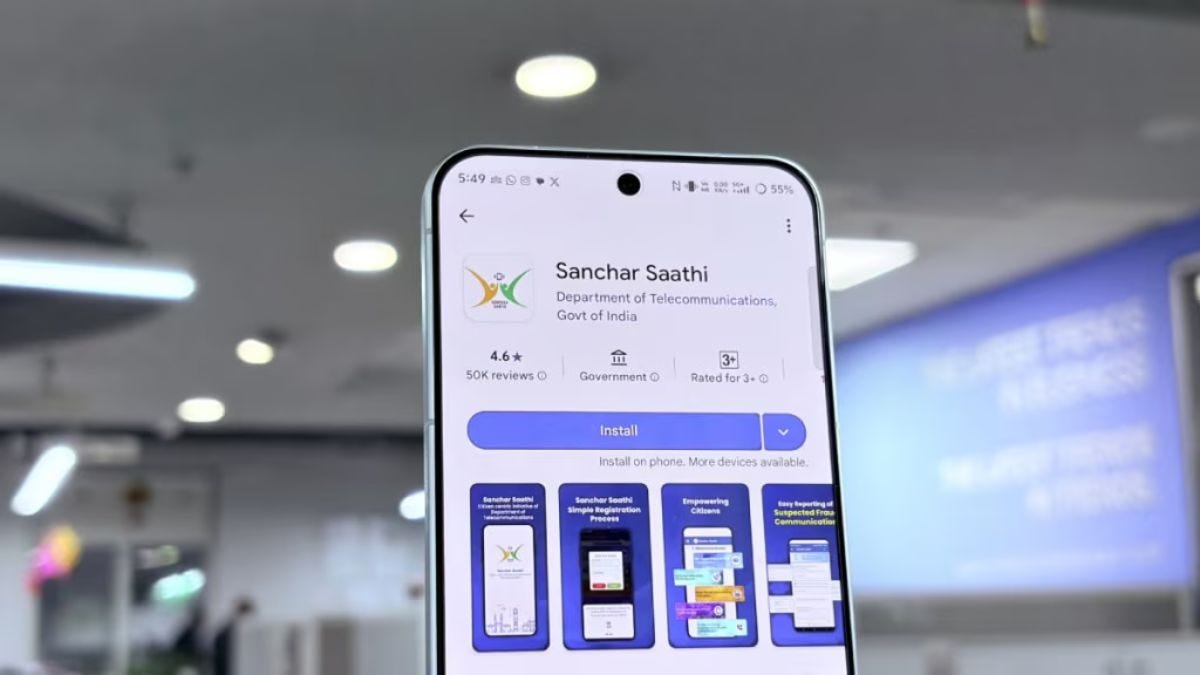
The Mandate: The Department of Telecommunications (DoT) has issued a directive requiring all smartphone manufacturers to pre-install the ‘Sanchar Saathi’ app on all devices sold in India.
The Hard Line: Manufacturers have a strict 90-day window to comply; the app must be “readily visible,” cannot be deleted, and legacy devices must receive it via mandatory updates.
The Resistance: Apple is reportedly refusing to comply, citing global security protocols that prohibit pre-loading third-party apps with system-level privileges.
The Official Stance: Minister Jyotiraditya Scindia stated users can delete it, directly contradicting the written DoT order which mandates functionalities must not be disabled.
It is a marvel of modern governance when a minister says, “You can delete it,” while the official circular says, “You absolutely cannot.” It’s Schrödinger’s App—simultaneously optional and mandatory. The government seems to have confused “smartphone” with “ankle monitor,” creating a digital leash under the guise of benevolence.
Winter Session Freeze: The SIR Electoral Roll Standoff
The Disruption: Lok Sabha was adjourned twice as Opposition MPs stormed the Well, demanding a discussion on the Special Intensive Revision (SIR) of electoral rolls.
The Allegation: Opposition leaders claim the SIR is being weaponized to systematically delete genuine voters in states like Maharashtra and Bihar.
The Statistics: In Gujarat alone, the SIR exercise identified and removed 15.58 lakh deceased voters and flagged 21.86 lakh voters who had permanently relocated.
The Counter-Move: Minister Kiren Rijiju stated the government is open to discussion but will not adhere to the Opposition’s disruptive tactics.
We spend crores to have representatives gather to discuss the nation’s future, only for them to play a high-stakes game of “who can scream slogans loudest” before lunch.
ECONOMY & BUSINESS
Wipro’s $375 Million Shopping Spree

The Deal: Wipro completed the acquisition of Harman’s Digital Transformation Solutions (DTS) unit for $375 million.
The Asset: Integrates 5,600 employees globally, boosting engineering and R&D capabilities.
The Strategy: Moves Wipro up the value chain from back-office support to high-end engineering and AI.
The Context: Indian IT faces a slowdown in traditional services due to AI automation.
While freshers struggle for offer letters, Wipro just “acquired” 5,600 employees. It’s the corporate equivalent of bulk buying at Costco. Why hire and train when you can buy a village of engineers? It makes the annual appraisal process feel like a merger meeting.
The Business Case: Indian IT is in a “pivot or perish” phase. The old labor arbitrage model is being eaten by AI. The new money is in Engineering R&D (ER&D). Wipro is buying competence in connected technologies, a defensive moat against the erosion of traditional BPO work.
The Snack Attack: Bikaji’s Dollar Bet
The Move: Bikaji Foods invested $250,000 in its US subsidiary to expand distribution.
The Growth: The US subsidiary’s turnover grew to $1.7M, signaling strong demand.
The Trend: FMCG brands are chasing the “nostalgia dollar” and the “exotic snack” market.
The Strategy: Investment reinforces commitment to the North American market.
Bhujia is going global. There is something satisfying about a Texan cowboy pairing beer with Bikaneri Bhujia. We are colonizing the West, one spicy packet at a time. Forget yoga; the real soft power is trans fats.
The Signal: Indian brands are reaching saturation in metros. The US offers higher margins. This signals “Ethnic” food moving from specialty aisles to mainstream supermarkets. Bikaji is betting the Western palate is evolving.
LAW & ORDER
Supreme Court on Bail: “Parity” is Not Enough
The Ruling: The SC held that parity with co-accused cannot be the sole ground for granting bail.
The Case: A murder case where the High Court granted bail simply because a co-accused received it.
The Principle: Bail must consider the gravity of the offence and the accused’s specific role.
The Implication: Sets a stricter precedent requiring individual merit assessment.
The Supreme Court killed the “teacher, he did it too!” defense. Criminal law is not a playground. Just because your partner had a better lawyer doesn’t mean you get a Get Out of Jail Free card.
The Legal Lens: This tightens judicial discretion. Lower courts often use “parity” as a lazy heuristic. The SC is forcing judges to write reasoned orders detailing individual culpability. This may clog bail courts but reduces the risk of dangerous criminals slipping through cracks.
INFRASTRUCTURE & ENVIRONMENT
11. GPS Spoofing: The Invisible War Over Delhi Skies

The Incident: Government confirmed civilian flights near Delhi Airport faced “GPS Spoofing,” causing navigation disruptions.
The Scope: Similar complaints from Chennai, Bengaluru, Kolkata, and Mumbai.
The Cause: Suspected fallout from military electronic warfare exercises or border interference.
The Consequence: Pilots reported counterfeit signals, forcing a switch to contingency navigation.
The Security Lens: This is a major safety threat. Spoofing sends fake signals, tricking computers. Occurring at major hubs suggests sophisticated Electronic Warfare capabilities are nearby. It exposes the fragility of civilian satellite navigation.
The 16-Storey Railway Station: Ahmedabad’s “Vertical” Dream
The Project: Ahmedabad will get India’s first 16-storey railway station, integrating Bullet Train, Metro, and Rail.
The Timeline: Slated for completion by July 2027.
The Concept: A “multimodal transport hub” designed to maximize land use.
The Integration: Located above Western Railway platforms, linking directly to the Metro.
A 16-floor station? Finally, a place to catch a train and buy overpriced coffee while missing said train. Let’s hope the elevators work, or we’ll have very fit, very angry commuters.
The Urban Shift: Vertical integration is the only way to manage high-speed rail in dense cities. If successful, this “Transit-Oriented Development” will be the blueprint for New Delhi and Mumbai.
TECHNOLOGY & SCIENCE
Sanchar Saathi (Part II): The “SIM Binding” Mandate
The Detail: DoT ordered OTT apps (WhatsApp) to remain “SIM-bound” and mandated IMEI registration.
The Goal: To prevent scams where criminals use spoofed numbers or stolen devices.
The Constraint: Prevents using communication apps on devices without the primary SIM.
The Enforcement: Action under Telecommunications Act 2023 for non-compliance.
The Wit: The government wants to bind your SIM, phone, and soul to Aadhaar. Soon, you won’t be able to call unless three satellites and a constable agree it’s you. It’s “Two-Factor Authentication” on steroids.
The Tech Reality: “SIM Binding” is standard for banking but radical for communication apps. It kills anonymity and secondary device usage. It aligns with the push to de-anonymise the internet, making every action traceable.
REGIONAL & MISCELLANEOUS
Rajasthan Police Warning: The “SIR” Cyber Fraud
The Scam: Cybercriminals are exploiting the “Special Intensive Revision” (SIR) to defraud people.
The Modus Operandi: Scammers pose as election officials, asking for OTPs to “prevent deletion” from rolls.
The Irony: A verification process is being used to steal identity.
The Advisory: Citizens urged not to share OTPs.
There is no scheme Indian scammers cannot monetize. “Hello, give OTP or your democracy is cancelled.” If they ran startups, we’d have 100 more unicorns.
The Warning: Political panic around SIR creates a “fear environment” for social engineering. Public anxiety is the hacker’s best friend.
Cyclone Ditwah: The Storm that Missed
The Event: Cyclone Ditwah brought rains to TN/Sri Lanka but spared Chennai major damage.
The Impact: Schools in Chennai/Tiruvallur closed as a precaution.
The Relief: Heavy rain occurred, but catastrophic wind damage was avoided.
The Geopolitics: India evacuated stranded nationals from Sri Lanka.
The “Expired” Relief Aid Row
The Spat: Pakistan sent relief aid to Sri Lanka; netizens claimed goods were expired.
The Blame: Pakistan accused India of delaying airspace clearance; India refuted this.
The Contrast: India conducted Operation Sagar Bandhu, providing swift relief.
The Optics: A diplomatic embarrassment for Pakistan.
Sending expired food is the diplomatic equivalent of regifting old fruitcake. Pakistan blaming India for the delay is comedy—”We would have sent fresh food if you let us fly faster!”
The Soft Power: India cements its role as the “First Responder” in the region, contrasting sharply with Pakistan’s fumbling.
🌍 World Watch
Top 10 Global Developments: Geopolitics & Tech
The Trump Ultimatum: “Leave Now or Else”

The News: Trump reportedly issued an ultimatum to Venezuelan President Nicolás Maduro: “Leave power... or face consequences.”
The Offer: Safe passage if he resigns; threat of land attacks if he refuses.
The Response: Maduro refused, demanding “global amnesty.”
The Chessboard: A return to the Monroe Doctrine. Trump signals aggressive unilateralism for his term.
China’s Reusable Rocket: The “SpaceX” Clone?
The Event: China is prepping the Zhuque-3 reusable rocket and delivered a sea recovery platform.
The Tech: Vertical landing capability similar to Falcon 9.
The Goal: Lower costs for megaconstellations.
The Signal: The SpaceX monopoly is ending. China is industrializing space access.
Haiti on Fire: Gangs & Deportations
The Crisis: Gangs control 50% of central Haiti; police admit “security failure.”
The US Move: Trump admin ends Temporary Protected Status for 340,000 Haitians.
The Impact: Forced return to a failed state promises a humanitarian catastrophe.
The “Khatakhat” Swiss Referendum
The Vote: Swiss rejected a 50% inheritance tax.
The Global Context: Voters prioritized economic stability over wealth redistribution.
The Signal: Capital flight scares voters even in wealthy democracies.
🌻 The Good Stuff
Top 10 Uplifting Stories
🏏 The Wonder Kid: 14-year-old Vaibhav Suryavanshi smashed a 58-ball century in the Syed Mushtaq Ali Trophy, the youngest ever to do so. 🔗
🔬 Science Whiz-Kids: India won 2 Gold and 4 Silver medals at the International Junior Science Olympiad in Russia. 🔗
🚀 Student Innovation: A 14-year-old won a $25,000 STEM award for an ultra-light “origami structure” for space. 🔗
🔍 The Deep Dive
The Masterclass: The Privacy Paradox of Sanchar Saathi
The Headline: Why a “Safety App” has Apple and Privacy Activists in a Standoff.
Imagine you buy a house. You own the keys. But the government insists a security guard—hired by them—must live in your living room. He promises he won’t look at private conversations, he’s just there to stop burglars. But he cannot be fired, and he cannot be locked out.
This is the essence of the Sanchar Saathi controversy.
The Mechanism: The Government of India has ordered that every smartphone sold must have the ‘Sanchar Saathi’ app pre-installed. But this isn’t just an app like Candy Crush. It is mandated as a System Application.
User Apps (like WhatsApp) ask: “Can I use your camera?” You can say no.
System Apps often have “privileged access,” bypassing these prompts because they are trusted by the OS.
The Friction: Apple operates on a “Zero Trust” model. They don’t allow external apps system-level privileges because it creates a “backdoor.” If hackers find a flaw in Sanchar Saathi, they could hijack millions of phones. Apple refuses to comply because it breaks their security architecture.
The “Bowl Theory” of Privacy: Think of your phone as a sealed bowl of water. It’s safe. The government wants to drill a hole to “drain out the bad water” (fraudsters). But once you drill a hole, any water can leak out, and anything can enter. Privacy activists argue that forcing a government backdoor for “safety” compromises the device’s integrity.
Why It Matters: This is a test case for Digital Sovereignty. If India succeeds, other nations will follow. We are moving from owning devices to renting terminals the state can inspect. The intent (stopping fraud) is noble; the method is a digital warrantless search.
🏁 Sign-Off
Question of the Day: If you had to choose between a phone that is 100% secure from hackers but the government has a key, OR a phone that is private from the government but vulnerable to hackers—which one do you buy?
Stay sharp, stay curious. - Aditya S. Editor-in-Chief, OneRead.News